
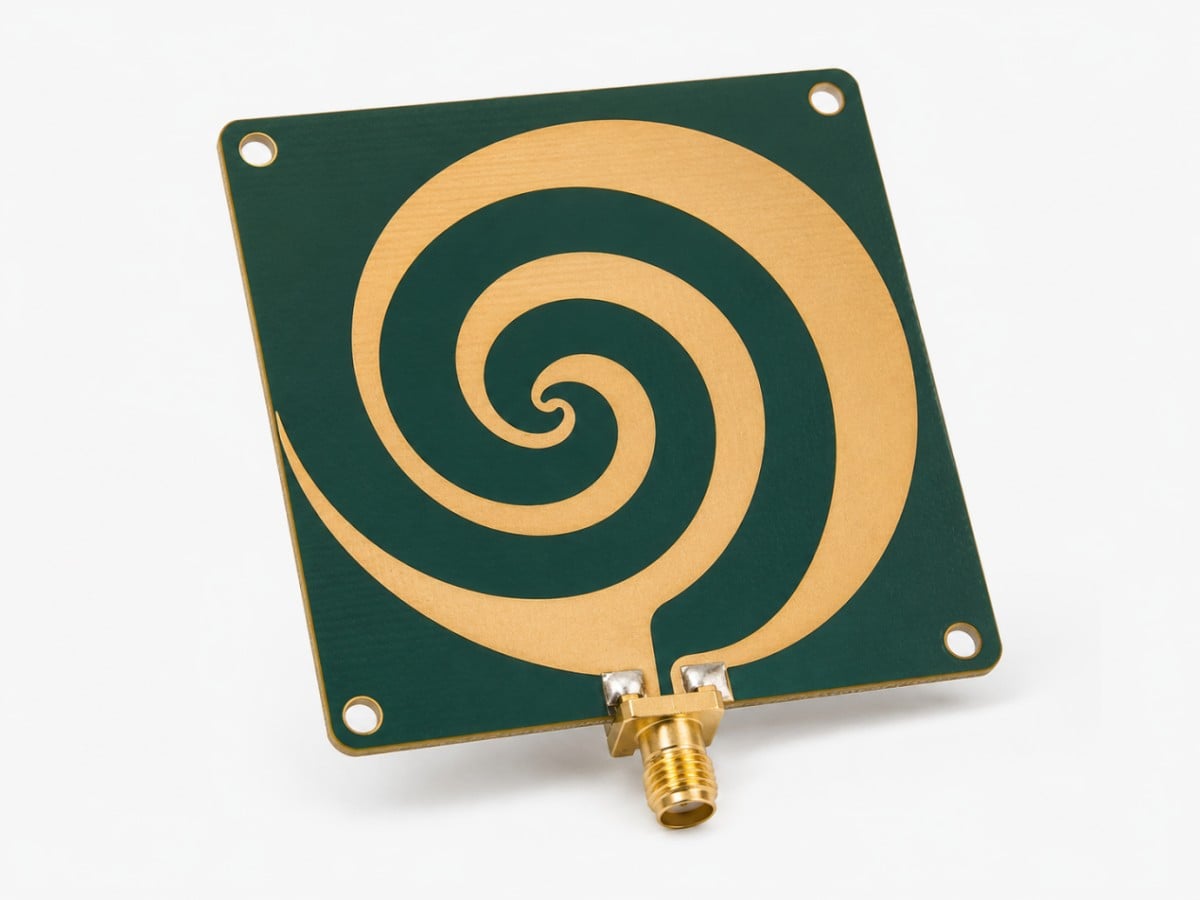
A log-spiral antenna, also known as an equiangular spiral antenna, is a classic frequency-independent antenna. Its arms are formed by two equiangular spiral curves. Since the geometry is defined by angles rather than fixed linear dimensions, the antenna can naturally “scale” its active region at different frequencies, radiating from the corresponding circumference as if continuously adjusting its own ruler.
When the antenna is fed, current travels along the spiral arms while gradually attenuating. The section within approximately one wavelength forms the effective radiation region, while the current farther along the arms becomes very weak and can be naturally truncated. This is known as the current truncation effect. Regardless of frequency changes, the effective region always remains at the corresponding wavelength position, enabling extremely wide bandwidth performance.
Common planar log-spiral antennas provide bidirectional radiation and circular polarization, while conical log-spiral antennas can achieve unidirectional, highly directional beams. They are widely used in satellite communications, broadband radar, and other advanced RF applications.
A log-spiral antenna can be imagined as a pattern that can “grow or shrink” by itself. Its metallic arms follow a special curve whose shape remains the same whether enlarged or reduced. As a result, it is highly tolerant of frequency variation: when the frequency changes, the antenna automatically uses the corresponding part of the spiral to radiate the signal.
This type of antenna can cover a wide frequency range, from tens of megahertz to several gigahertz, without switching. Planar versions radiate in both directions, while conical versions focus energy in one direction. They are commonly found in applications requiring wide bandwidth, circular polarization, and stable radiation patterns, such as satellite communications, pulse radar, and radio astronomy.
The antenna introduced today features a compact size, a PCB-based structure for fast manufacturing, and a frequency range covering 0.8 GHz to 18 GHz, with good VSWR performance across the band. It is commonly used in OTA testing for mobile phone production.

 EN
EN