
 EN
EN
The global market for wearable technology is undergoing a massive transformation. Once limited to basic fitness trackers and digital watches, today’s wearables include sophisticated medical-grade health monitors, smart rings, industrial safety gear, and advanced Augmented Reality (AR) glasses. As consumers and enterprise users demand sleeker designs, longer battery lives, and reliable multi-band connectivity, device manufacturers face unprecedented engineering challenges.
Among these challenges, RF (Radio Frequency) design is perhaps the most critical. Wearable devices must house multiple antennas—ranging from Bluetooth and Wi-Fi to GPS/GNSS and Cellular IoT (NB-IoT/LTE-M)—within extremely constrained physical spaces. In this context, miniature ceramic antennas have emerged as the gold standard for wearable wireless design.
As a leading developer and manufacturer of RF microwave components, Jiaxing Ruishang Electronic Technology Co., Ltd. (RSwave) (visit www.rswave.com) specializes in high-performance dielectric and ceramic antennas that address the tight space and high-efficiency requirements of modern wearable applications. This article explores how miniature ceramic antennas work, their unique advantages in wearable devices, design methodologies, and their future outlook in the IoT ecosystem.
1. Understanding Miniature Ceramic Antennas: The Dielectric Loading Advantage
To understand why ceramic antennas are ideal for wearables, it is essential to look at the physics of antenna size. The physical size of a traditional resonant antenna (such as a PCB trace antenna or a whip antenna) is directly proportional to the wavelength (λ\lambdaλ) of the signal it is designed to transmit or receive.
For instance, the wavelength of a 2.4 GHz Bluetooth signal in free space is approximately 12.5 cm. A standard half-wave dipole antenna would need to be roughly 6.2 cm long, which is far too large for a smart ring or a compact fitness band.
Ceramic antennas overcome this limitation through the dielectric loading effect. The wavelength of an electromagnetic wave traveling through a material is inversely proportional to the square root of the material's relative permittivity (or dielectric constant, ϵr\epsilon_rϵr):
λmedium=λfree_spaceϵr\lambda_{medium} = \frac{\lambda_{free\_space}}{\sqrt{\epsilon_r}}λmedium=ϵrλfree_space
By utilizing advanced ceramic materials with high dielectric constants (typically ranging from ϵr=10\epsilon_r = 10ϵr=10 to over 909090), manufacturers can dramatically compress the electromagnetic wave inside the ceramic substrate. This allows a ceramic antenna to achieve resonance at the desired frequency while occupying only a fraction of the physical space required by traditional antennas.
2. Key Advantages of Ceramic Antennas in Wearable Devices
For wearable developers, miniature ceramic antennas (such as ceramic chip antennas and ceramic patch antennas) offer several distinct benefits over PCB trace antennas or metal stamped antennas:
Ultra-Small Footprint
Ceramic chip antennas can be as small as 3.2×1.6 mm3.2 \times 1.6 \text{ mm}3.2×1.6 mm or even 1.6×0.8 mm1.6 \times 0.8 \text{ mm}1.6×0.8 mm for 2.4 GHz applications. This minimal footprint frees up valuable PCB real estate for other critical components, such as microcontrollers, sensors, and larger batteries.
Resistance to Human Body Detuning (Body-Loading Effect)
The human body is composed primarily of water, which acts as a lossy dielectric material with high permittivity (ϵr≈50\epsilon_r \approx 50ϵr≈50 to 808080 depending on the tissue type). When a standard antenna is placed close to the human body, the body absorbs the RF energy and pulls the antenna's resonant frequency downward (detuning).
Ceramic antennas, because they concentrate the electromagnetic field tightly within their high-permittivity ceramic cores, are significantly less sensitive to the proximity of the human body. This characteristics ensures stable wireless performance whether the device is worn on the wrist, finger, or head.
Omnidirectional Radiation Patterns
Wearable devices are constantly in motion. A smartwatch must maintain its GPS lock or Bluetooth connection whether the wearer is running, swimming, or swinging their arms. Ceramic chip antennas offer near-isotropic radiation patterns, providing reliable, multidirectional coverage that minimizes signal drops during motion.
Ease of Manufacturing (SMT Compatibility)
Unlike wire antennas or custom stamped metal antennas that require manual assembly or complex mechanical housings, ceramic chip antennas are Surface Mount Devices (SMD). They can be picked and placed onto the PCB using standard high-speed automated assembly lines, lowering production costs and improving manufacturing yield.
3. Key Applications in Wearable Technology
Miniature ceramic antennas are utilized across a wide variety of wireless protocols in the wearable sector:
A. High-Precision GNSS / GPS Tracking
For smartwatches, outdoor sports trackers, and elder-care tracking devices, reliable satellite positioning is vital. Because GPS signals travelling from medium Earth orbit are weak by the time they reach the ground, high-efficiency antennas are mandatory.
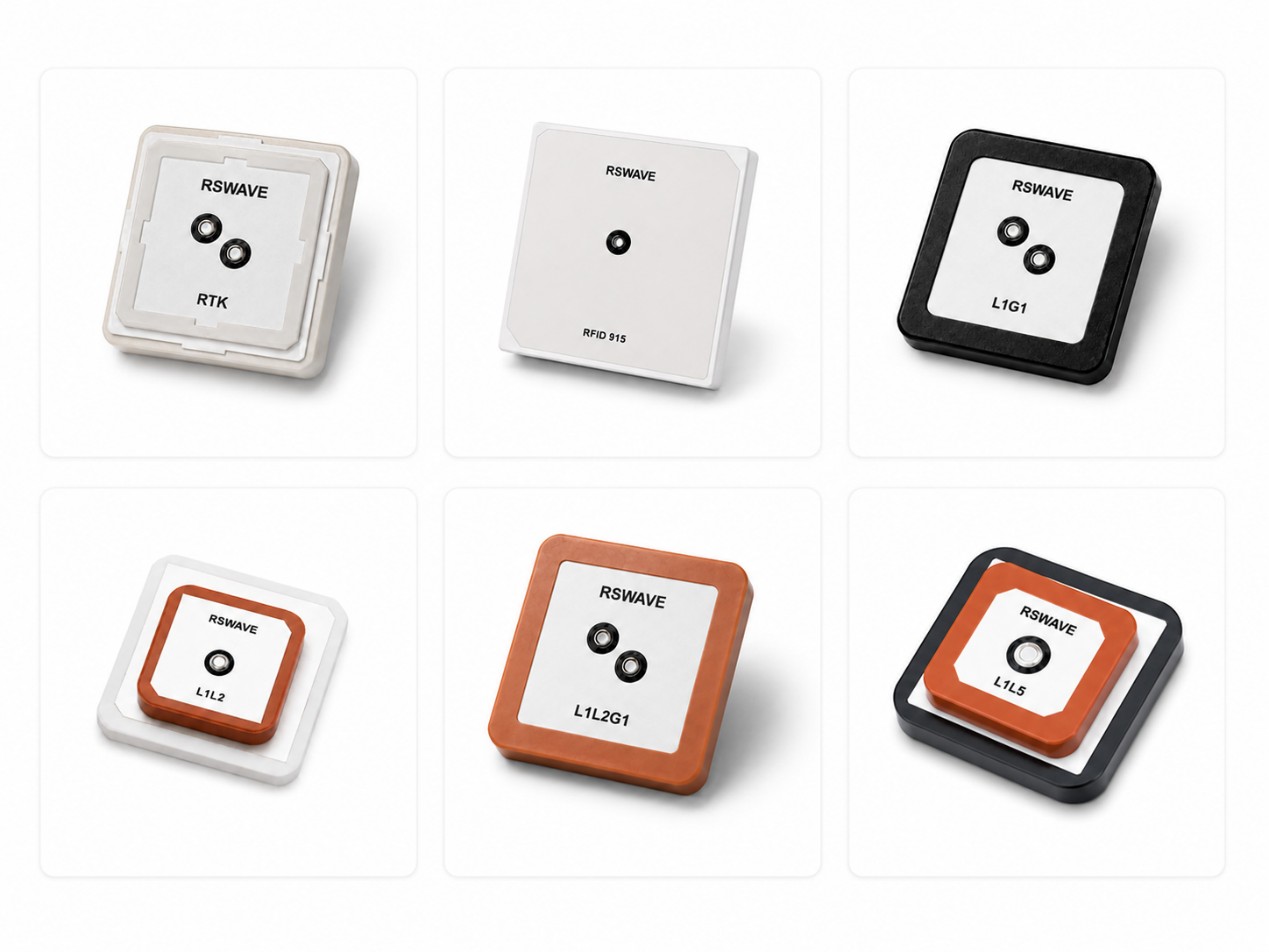
For these applications, ceramic patch antennas (such as RSwave’s passive dielectric patches) are the preferred choice. These antennas leverage circular polarization (RHCP) to align with GPS/GLONASS satellite signals, offering high gain and excellent multipath rejection in a compact 10×10 mm10\times10\text{ mm}10×10 mm or 12×12 mm12\times12\text{ mm}12×12 mm form factor.
B. Bluetooth Low Energy (BLE) and Wi-Fi
BLE is the backbone of wearable data synchronization, linking smart bands to smartphones. For micro-wearables like smart rings or earbuds, ultra-small 2.4 GHz ceramic chip antennas are critical. They allow seamless audio streaming and biometric data transfer while fitting into curved, ultra-compact housings.
C. Cellular IoT (NB-IoT & LTE-M)
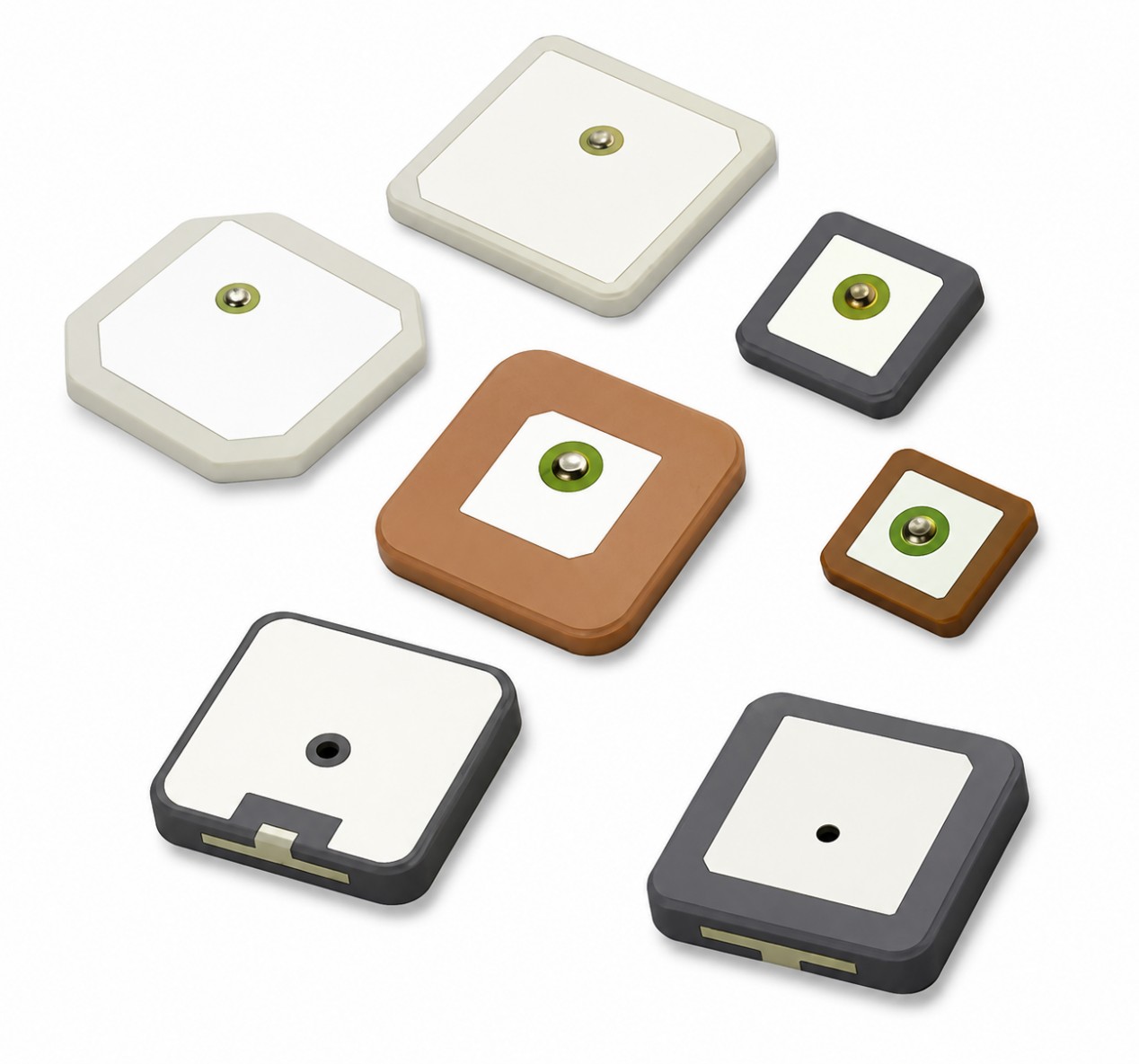
As wearables become independent of smartphones, many are integrating cellular connectivity. Cellular bands (spanning 700 MHz to 2.2 GHz) require wider bandwidths. RSwave’s miniature multi-band ceramic antennas allow compact devices to connect directly to cellular networks, enabling real-time medical monitoring and emergency tracking.
4. RF Engineering & Integration Best Practices
While ceramic antennas offer significant advantages, their performance is highly dependent on the layout of the host PCB. To achieve optimal performance and pass regulatory certifications (such as FCC/CE), RF designers must adhere to several integration guidelines:
The Crucial Role of the Ground Plane
A common misconception is that a ceramic chip antenna works completely independently. In reality, a ceramic chip antenna acts as one half of a dipole system; the PCB ground plane acts as the other half. The size and shape of the ground plane dictate the radiation efficiency and bandwidth of the antenna. Designers must maintain the manufacturer-specified "ground clearance area" (an area of the PCB free of copper planes and traces directly beneath and around the antenna) to prevent detuning.
Implementing Matching Networks
Because every wearable enclosure, battery placement, and plastic housing alters the local dielectric environment, the antenna’s input impedance will deviate from the nominal 50 Ω50\ \Omega50 Ω. Incorporating a π\piπ-type matching network (comprising two shunt components and one series component, using high-Q inductors and capacitors) adjacent to the antenna feed point is essential. This allows engineers to tune the system back to resonance during the prototyping phase.
Co-Existence and Isolation
Modern wearables pack GPS, Wi-Fi, Bluetooth, and cellular transmitters close to each other. To prevent receiver desensitization (desense) and intermodulation distortion, designers must place the antennas as far apart as possible, utilize orthogonal polarization orientations, or use bandpass filters (such as RSwave’s LTCC dielectric filters) to isolate adjacent bands.
5. Future Trends: Next-Generation Ceramic Antennas
As the industry moves toward 5G RedCap (Reduced Capability), Wi-Fi 6E/7, and Ultra-Wideband (UWB) tracking, ceramic antenna technology continues to evolve:
- Flexible and Conformal Ceramics: Materials researchers are developing flexible ceramic-polymer composites that can be molded to conform to the curved surfaces of wearable housings, maximizing space efficiency.
- Antenna-in-Package (AiP): Integrating the RF transceiver chip and the ceramic antenna into a single semiconductor package to eliminate interconnect losses and minimize footprint.
- High-Permittivity Materials for Sub-6GHz 5G: The development of newer ceramic compositions with low loss tangents at higher frequencies, enabling highly efficient, miniaturized 5G IoT devices.
Conclusion
Miniature ceramic antennas represent a crucial enabling technology for the wearable device revolution. By offering an unmatched balance of compact size, resistance to body detuning, high reliability, and surface-mount convenience, they allow engineers to push the boundaries of what wearable technology can achieve.
For developers seeking to integrate cutting-edge wireless capabilities into their wearable products, partnering with an experienced RF component specialist is key. Jiaxing Ruishang Electronic Technology Co., Ltd. (RSwave) offers a comprehensive portfolio of high-quality ceramic patch antennas, chip antennas, and dielectric components designed to meet the rigorous demands of the global electronics industry. Explore RSwave’s product line and access technical datasheets at www.rswave.com to optimize your next wearable RF design.