
 EN
EN
In an RF front end, signal purity is rarely determined by one active device alone. Before a wanted signal reaches the low-noise amplifier, mixer, transceiver, or analog-to-digital converter, it must coexist with blockers, harmonics, adjacent-channel energy, transmitter leakage, and broadband noise. If these unwanted components are not controlled early, they can reduce receiver sensitivity, compress active stages, create intermodulation products, or raise the noise floor. This is why filtering remains one of the most important functions in modern RF architecture.
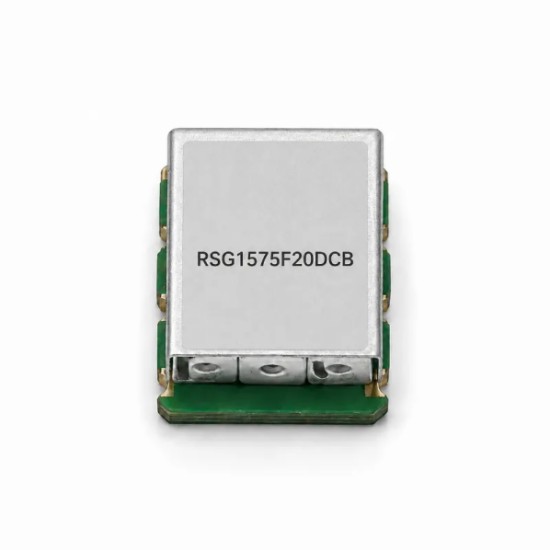
Microwave dielectric ceramic filters are especially useful when designers need compact size, low loss, stable frequency response, and strong out-of-band rejection. RSWave, the RF and microwave product brand of Jiaxing Ruishang Electronic Technology Co., Ltd., lists microwave dielectric ceramic filters among its core product families for 5G/5G-A base stations, satellite communication, radar, T/R modules, Wi-Fi equipment, repeaters, and other RF front-end applications.
Why Signal Purity Matters Before Amplification
An RF front end must preserve the desired channel without allowing unwanted spectral content to consume dynamic range. A strong interferer just outside the operating band may be much larger than the wanted signal. Even if digital processing can later separate channels, an excessive blocker may already have pushed an LNA or mixer into a less linear region.
A well-selected band-pass filter limits that problem at the hardware level. It passes the intended frequency range while attenuating energy outside the band. The result is a cleaner signal environment for downstream stages and lower risk of unwanted mixing products.
A filter does not improve the wanted signal by adding gain. Instead, it improves the relationship between useful in-band energy and unwanted out-of-band energy. For receiver designers, purity therefore depends on selectivity with the lowest practical penalty in insertion loss.
What Makes Dielectric Ceramic Filtering Different
The resonant element inside this filter type uses microwave dielectric ceramic material with a high dielectric constant, low dielectric loss, and good temperature stability. High-permittivity material shortens the electromagnetic wavelength inside the resonator, helping reduce component dimensions compared with structures that would otherwise need a larger resonant volume.
A high-Q resonator can also store RF energy efficiently. In filter design, higher Q generally supports lower loss and sharper frequency discrimination, although the final result still depends on coupling topology, resonator count, package construction, bandwidth, and matching. Research on dielectric resonator filters similarly identifies high permittivity, low loss, and thermal stability as key reasons these materials are attractive for microwave filtering.
Four Ways These Filters Can Clean Up an RF Front End
1. Suppressing Out-of-Band Blockers
The most direct contribution is stopband attenuation. Cellular, satellite, radar, navigation, and industrial wireless systems often operate in crowded spectral environments. A ceramic filter can be designed so that the wanted channel lies in the low-loss passband while nearby or remote interferers fall into attenuation regions.
This matters before the LNA as well as between gain stages. Front-end rejection reduces the unwanted power presented to nonlinear devices, helping the receiver preserve usable dynamic range.
2. Reducing Harmonic and Spurious Energy
Transmitters, frequency converters, PLL chains, and power amplifiers can generate harmonics or spurious tones. Depending on the architecture, a band-pass filter can suppress components outside the allocated band before they reach an antenna, duplexer path, or subsequent RF module.
This is especially useful in tightly integrated equipment where several radios share a small enclosure and isolation cannot depend on physical spacing alone.
3. Preserving the Wanted Signal with Controlled Insertion Loss
A filter that rejects interference but introduces excessive passband loss can degrade receiver noise figure. Insertion loss should therefore be evaluated together with stopband attenuation.
4. Keeping Selectivity Stable as Temperature Changes
Frequency drift can move a passband away from the intended channel or weaken rejection where it is needed most. Dielectric ceramic materials are widely used partly because their resonant behavior can be engineered for temperature stability.
RSWave highlights temperature stability as a core feature of its dielectric ceramic filter range. For outdoor radio equipment, base stations, industrial terminals, and navigation devices, stable resonance helps maintain predictable RF behavior as ambient conditions change.
Which Specifications Should Engineers Examine First?
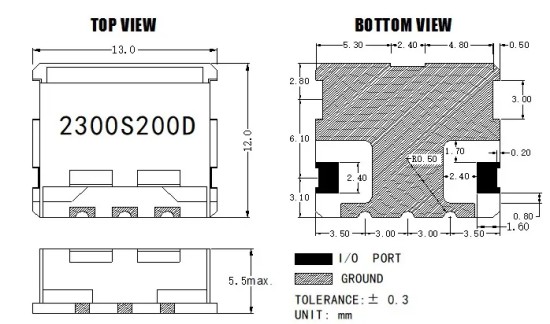
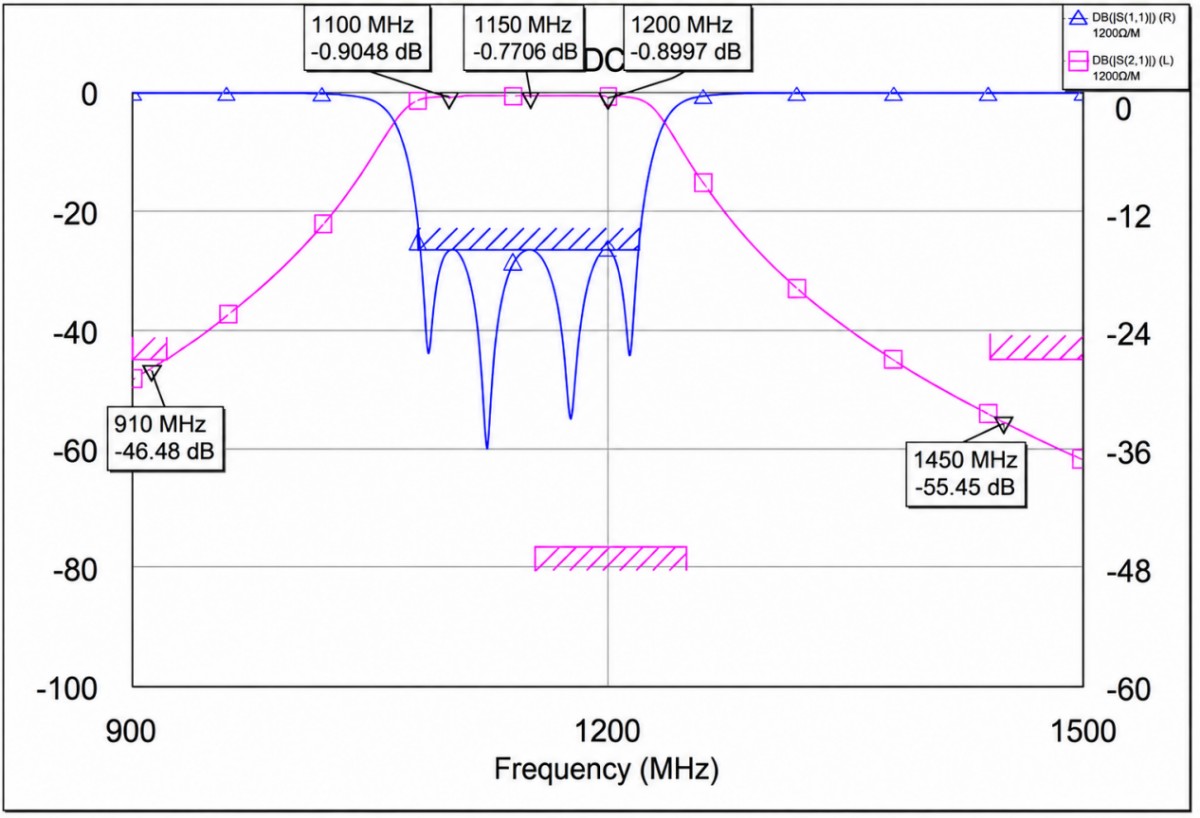
A reliable filter decision starts with the system requirement, not the package appearance. Designers should review center frequency, passband bandwidth, insertion loss, ripple, VSWR or return loss, rejection at defined offset frequencies, dimensions, mounting method, power level, and operating temperature.
Stopband attenuation must always be read together with the frequency at which it is specified. “50 dB rejection” has limited meaning unless the specification also states where that rejection occurs. The same is true for bandwidth: a narrowband filter may offer strong selectivity but may not suit a wide-modulation signal.
Mechanical integration matters too. Grounding, PCB transitions, nearby conductive structures, and enclosure coupling can alter measured performance. A sound engineering practice is to evaluate the filter in a representative RF layout and verify S-parameters with a calibrated vector network analyzer.
Where Ceramic Filters Fit in Real RF Architectures
In a 5G or 5G-A base-station radio, filtering helps isolate the intended receive or transmit band in dense spectrum. In radar, it can suppress unwanted emissions and reduce out-of-band interference before sensitive receiver stages. In satellite communication, low-loss frequency selection matters because link budgets are tightly controlled. In Wi-Fi routers, repeaters, and wireless terminals, compact passive filtering can improve coexistence when multiple radios operate close together. RSWave identifies these areas among the principal applications for its dielectric ceramic filters.
Navigation systems provide another example. RSWave’s filter table includes models associated with GPS/BDS applications, while the company also supplies dielectric ceramic antennas and GNSS antennas. This reflects a practical RF-front-end reality: antenna and filter performance are often considered together because both influence the signal delivered to the receiver.
Why Customization Can Matter More Than a Catalog Part
Many RF systems do not fit a standard center frequency, bandwidth, rejection mask, or mechanical envelope. RSWave states that its microwave dielectric ceramic filters can be customized and that it supports simulation-based design. The product page describes a frequency range of approximately 400 MHz to 7 GHz.
For an OEM, the useful question is not simply, “Which filter is available?” It is, “What response does the front end require at the frequencies that can actually cause a system problem?” A custom design may prioritize a specific blocker, lower loss in a narrow passband, smaller dimensions, or a mounting format that simplifies PCB integration.
A clear requirement table helps. Useful inputs include center frequency, operating bandwidth, maximum insertion loss, minimum return loss, attenuation points, source/load impedance, power, temperature range, and size limit.
The Practical Takeaway
Signal purity in an RF front end is the result of disciplined spectrum management before unwanted energy reaches sensitive or nonlinear circuitry. Microwave dielectric ceramic filters provide a practical way to combine compact dimensions, selective frequency response, low-loss transmission, and temperature-stable resonant behavior.
For 5G, satellite communication, radar, navigation, repeaters, Wi-Fi, and other RF applications, the most effective filter is the one designed around the actual interference environment and link budget. RSWave’s published portfolio includes narrowband, wideband, cellular, navigation, IoT, and 5G examples, with custom-frequency options for requirements outside the standard list.
When filter selection is treated as part of the RF architecture rather than a final component choice, it can do more than remove noise. It can protect dynamic range, reduce blocker energy, stabilize channel selectivity, and give the rest of the RF chain a cleaner signal to process.
Table of Contents
- Why Signal Purity Matters Before Amplification
- What Makes Dielectric Ceramic Filtering Different
- Four Ways These Filters Can Clean Up an RF Front End
- Which Specifications Should Engineers Examine First?
- Where Ceramic Filters Fit in Real RF Architectures
- Why Customization Can Matter More Than a Catalog Part
- The Practical Takeaway