
Abstract: In today's hyper-connected world, wireless communication devices are rapidly evolving towards miniaturization, high performance, and multi-functionality. Traditional antennas often struggle to balance size and performance. Ceramic antenna arrays, a novel solution combining high-performance ceramic materials with array antenna technology, are emerging as a core technology in cutting-edge fields from 5G terminals to satellite communications, thanks to their exceptional integration, bandwidth, and radiation efficiency. This article provides an in-depth analysis of their working principles, core design elements, and a comprehensive overview of their wide-ranging applications.
I. Core Principles of Ceramic Antenna Arrays
The principle of ceramic antenna arrays rests on two technological pillars: high-performance ceramic dielectric materials and array antenna theory.
1. Material Foundation: Ceramic Dielectric Resonators
Unlike traditional metal antennas that rely on conductor surface current radiation, ceramic antennas (more accurately, Dielectric Resonator Antennas, DRAs) utilize dielectric resonance. The selected ceramic materials (such as barium strontium titanate, barium titanate) possess these key characteristics:
• High Permittivity: The wavelength of an electromagnetic wave within the dielectric shortens to 1/√ε_r of its wavelength in air. This allows for a significant reduction in antenna size, enabling miniaturization.
• Low Loss Tangent: The material's intrinsic absorption loss of electromagnetic energy is very low, ensuring high radiation efficiency.
• Adjustable Temperature-Frequency Characteristics: Stability under different environmental conditions can be achieved by adjusting the material composition.
When the ceramic body's dimensions approach half the dielectric wavelength, specific electromagnetic resonance modes (e.g., TE or TM modes) are excited, creating strong fringing fields at the ceramic body's surfaces. These fields couple with free space, enabling effective electromagnetic radiation.
2. Array Empowerment: Beamforming and Performance Enhancement
While a single ceramic antenna element offers superior performance, its capabilities are limited. Arranging multiple ceramic antenna elements in a specific geometry (linear, planar, or conformal) to form an "array" achieves a qualitative leap:
• Beamforming and Scanning: By controlling the amplitude and phase of the signal fed to each element, the array's radiation pattern can be precisely shaped. Using phase shifters for phase control enables electronic scanning of the main beam in space without mechanical movement.
• High Gain and Strong Directivity: The array coherently combines the radiated energy from multiple elements in space, achieving gain and directivity far superior to a single element in specific directions.
• Flexible Beam Control: Algorithms (e.g., adaptive beamforming) can dynamically adjust beam shape, enabling intelligent functions like steering nulls toward interference sources or tracking target users.
3. Brief Working Principle Summary
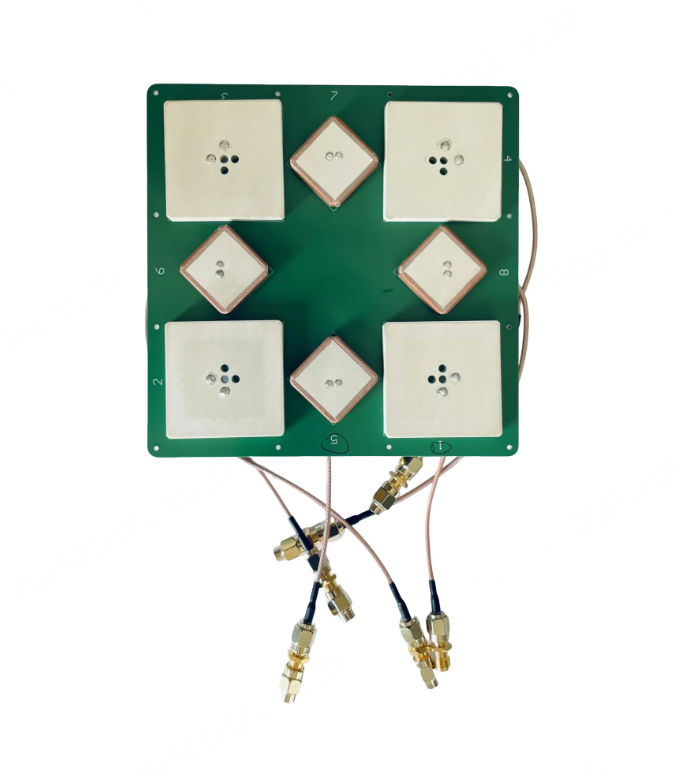
In a ceramic antenna array, the RF signal excites resonance in each ceramic element via a feeding network (e.g., microstrip line, coaxial probe, or aperture coupling). The spherical waves radiated from each element interfere in the far-field region. By meticulously designing the element spacing (typically about half the free-space wavelength to avoid grating lobes) and the feed distribution, the radiation from all elements adds in-phase and strengthens in the desired direction, while cancelling out in undesired directions, thus forming a sharp, controllable beam.
II. Design and Key Considerations for Ceramic Antenna Arrays
Designing a high-performance ceramic antenna array is a complex systems engineering task, requiring a balance of the following elements:
• Element Design: Determining the ceramic block's shape (rectangular, cylindrical, hemispherical), size, and material parameters to optimize its resonant frequency, bandwidth, and radiation pattern.
• Array Configuration: Selecting a 1D linear array, 2D planar array, or 3D conformal array based on application requirements. Element spacing is a critical parameter, requiring a balance between avoiding grating lobes and suppressing mutual coupling.
• Feeding Network: Designing an efficient, low-loss feed structure to provide the required amplitude and phase distribution. Modern designs often integrate with silicon-based or compound semiconductor integrated circuits for active control.
• Mutual Coupling Effect: Electromagnetic coupling between closely spaced elements alters element impedance and radiation characteristics, necessitating compensation through decoupling techniques or algorithms.
• Packaging and Integration: Ceramic antennas are easily integrated with PCB packaging, requiring consideration of thermal expansion coefficient matching, mechanical stability, and environmental protection.
III. Broad Application Domains
The unique advantages of ceramic antenna arrays make them indispensable in numerous demanding scenarios:
1. Fifth-Generation and Future Mobile Communications
• 5G/6G Smartphones and Terminals: Internal space is at a premium. Ceramic antenna arrays provide a compact solution for Massive MIMO and millimeter-wave beamforming, key to enabling high-speed, low-latency 5G communication.
• 5G Small Cells and Fixed Wireless Access: Used for dense urban coverage, their high gain and electronic scanning ability can precisely serve users, improving network capacity and energy efficiency.
2. Satellite Communications
• Low Earth Orbit Satellite Constellations (e.g., Starlink): Satellite platforms impose stringent requirements on antenna weight, volume, and reliability. Ceramic phased array antennas offer lightweight, low-profile, multi-beam generation, and fast beam-hopping capabilities, meeting the "communication on the move" needs of high-throughput satellites.
• Ground User Terminals: Portable or vehicular satellite terminals using ceramic arrays enable automatic, rapid satellite tracking for stable connection establishment.
3. Automotive Electronics and Autonomous Driving
• Automotive Radar: 77 GHz millimeter-wave ceramic antenna arrays are the core "eyes" of Advanced Driver-Assistance Systems and autonomous vehicles, used for precise detection of object distance, speed, and angle around the vehicle.
• Intelligent Vehicular Networking: Integrated V2X communication antennas enable reliable data exchange between vehicles and infrastructure.
4. Internet of Things and Wearable Devices
• IoT sensors, smartwatches, and other devices extremely sensitive to size and power consumption utilize miniature ceramic antenna arrays to maintain stable wireless connection performance within limited space.
5. Defense and Aerospace
• Systems for radar, electronic warfare, and secure communications require high-performance, highly reliable phased array antennas operating in extreme environments. The high-temperature stability and corrosion resistance of ceramic materials make them ideal.
IV. Future Outlook
Advancements in materials science (e.g., Low-Temperature Co-fired Ceramic technology), integrated circuits (silicon-based mmWave chips), and AI algorithms point to clear future trends for ceramic antenna arrays:
• Higher Frequency Bands and Wider Bandwidths: Moving into the terahertz range to support extreme data rates.
• Higher Integration: Evolving towards "Antenna-in-Package" and full integration with the RF front-end.
• Intelligence and Adaptability: Deep integration with AI for real-time environmental sensing and self-optimizing beam management.
• New Function Integration: Exploring the integration of sensing, energy harvesting, and other functions at the antenna array physical layer.
Conclusion
Ceramic antenna arrays are far from a simple stacking of antenna elements. They are the product of deep integration among materials science, electromagnetic theory, and signal processing algorithms. They elevate the "sensing organ" of wireless systems to a new level—smaller, smarter, and more powerful. From connecting every individual to connecting everything, from terrestrial networks to space-air-ground integration, ceramic antenna arrays, as the cornerstone of modern wireless information systems, are quietly driving a profound communication revolution, the boundaries of which continue to expand.

 EN
EN